What terminal must be grounded to provide a positive power source?
Key Terms
- Power supply
- Electrical circuit
- Switch
- Closed excursion
- Open excursion
Objectives
- Recognize the part and representation of a simple power supply
- Analyze a simple electrical circuit
- Identify the part of switches in a circuit
Electronic devices operate by applying voltages that create electric currents through diverse components. These currents can perform a number of functions: for example, they create estrus on an electric range (stove), they create light in a light seedling, and they carry data from point to betoken in a processor. So, how do we get a voltage and then we can perform these functions? The answer is what we can broadly call power supplies.
Please annotation: do not attempt to replicate the diagrams in this commodity. Doing so may consequence in electric shock, injury, or decease. These examples are provided only for theoretical discussion and non for actual/physical use.
Power Supplies
An electric power supply is a device or system that converts some form of free energy into electrical free energy. For case, a battery converts chemical free energy to electrical energy by way of chemical reactions that create a voltage across the two terminals (one of which is labeled "+" and the other "-"). In the instance of your electric utility visitor, the power plant burns coal or uses nuclear fuel to plow a turbine that, through the employ of magnets, generates a voltage that power lines conduct to your home. Solar panels convert the free energy in light to electrical free energy.
Whatever the source, a power supply converts some form of stored or otherwise available energy into electrical free energy. (According to a fundamental tenet of physics, energy is neither created nor destroyed--it can only change forms.) Merely what does a power supply look similar with regard to our discussion of voltage and current? Below is an illustration of a simple ability supply with a positive final and negative terminal. The positive terminal has a net positive charge, and the negative last has a internet negative charge. We'll call the negative final ground.
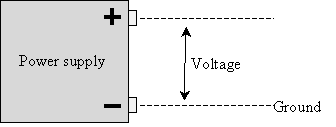
Because of the excess positive charge at the positive final and the excess negative charge at the negative terminal, a positive charge will be repelled from the positive concluding and attracted toward the negative terminal.
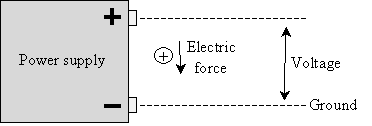
For analogy purposes, let's consider a 1.5V battery--this is the potential energy departure between the two battery terminals per coulomb of charge. We'll nonetheless call the negative terminal ground, considering a positive accuse will "fall" abroad from the positive terminal toward the negative terminal, every bit shown above. In the diagram beneath, we but assume that the battery is surrounded past air, which is an insulator (it doesn't carry charge).
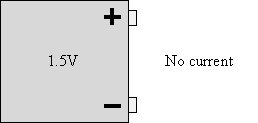

Only what if we connect a conducting material-such equally copper wire-across the terminals of the battery? We then have both a potential difference between the two terminals and a pathway for charge to travel. As a result, electric current volition flow from the positive terminal to the negative terminal.
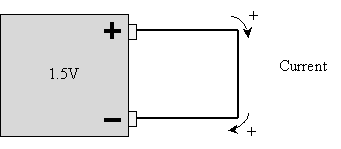

At this betoken, y'all may be a little confused as to why we are showing the flow of positive accuse. Call back that conductors allow the free menstruation of loosely bound electrons--thus, we would look that what would happen is that negative charge would catamenia from the negative terminal (where it is in backlog) toward the positive final (to residuum the positive accuse at that place). This is actually what happens, but by historical accident, positive charge was associated with protons rather than electrons (the charge of electrons could just accept legitimately been called positive). Every bit it turns out, a given flow of positive charge in 1 direction is equivalent to the same flow of negative charge in the opposite direction.
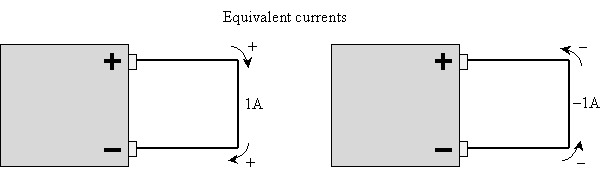

Merely to align our report with the conventions of physics, we'll more often than not talk well-nigh positive current--that is, positive charge flowing from a higher voltage (the positive concluding) to a lower voltage (ground). Incidentally, y'all shouldn't connect just a wire or other expert conductor to a battery in this style--it will very quickly exhaust the battery.
A Unproblematic Electric Circuit
What we see to a higher place, where the 2 terminals of a power supply (battery, for case) are connected to each other, is a uncomplicated electrical circuit. An electrical circuit is, as you can probably judge from the example to a higher place and the proper name, a closed loop through which current can menses. Because the excursion above contains no other components too the battery, however, it'due south not a very interesting case.
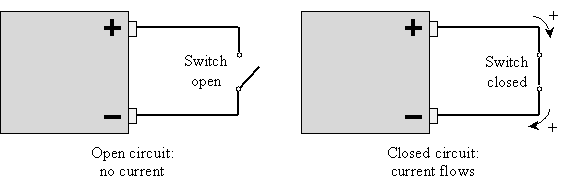
Notation that electrons tin but menstruum from i point in a fabric (or combination of materials) to another if at that place is a continuous path through conducting material (a conductor) between the points. In the simple circuit higher up, such a path exists between the battery terminals. But what if we introduce a break in the wire? Then, of grade, current volition non flow. If nosotros can "break" and "unbreak" the excursion at volition, and so we can plow on and off the flow of accuse: in other words, nosotros've introduced a switch into the circuit. Note that when the switch is closed (connecting the wire), the configuration is called a closed circuit. When the switch is open up, it is called an open up circuit.

Finally, permit's replace our bulky battery with a more conventional symbol for a ability supply--i that you'll usually come across in real-world diagrams of electrical circuits.
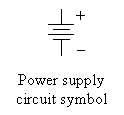

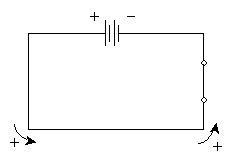
Note that the positive terminal is on the side with the longer horizontal bar; the negative concluding is on the side with the shorter bar. Both are labeled in a higher place, but these labels are generally non shown. Thus, our unproblematic switch circuit looks like the following.
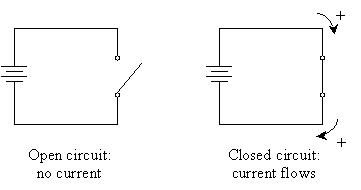

Thus, we have taken the first step into the world of electrical circuits. Again, even with the switch, this circuit is non all that interesting: all it does is speedily deplete the free energy stored in the battery when the circuit is closed. The important point to note, even so, is that by "breaking" the circuit, nosotros can command whether electric current is allowed to period. This useful approach allows usa to turn lights on and off at wall switches, for instance.
Practice Problem : Determine which way current will flow in the simple closed circuit shown below.
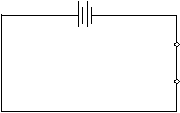
Solution: We learned that, past convention, we interpret current as the menses of positive charge from the positive (positively charged) terminal to the negative (negatively charged) last. The battery in the simple circuit above is oriented such that the positive terminal is on the left. Thus, current will menstruation in the counterclockwise direction

Practice Problem : Volition any current flow in the excursion beneath? Why or why not?
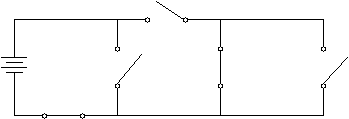
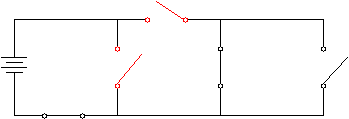
Although this circuit is a piffling more than complicated than the simple circuits we take seen thus far, we can apply the same principles we have already used. Call up that electric current only flows when there is a conducting path from a college voltage (the positive concluding of the power supply) to a lower voltage (or footing-the negative terminal). In this case, notation that the switches highlighted below are both open, giving the current no fashion to accomplish the negative terminal. Thus, no current flows in this circuit.
moralesmourrought.blogspot.com
Source: https://www.universalclass.com/articles/science/electronics/power-supplies-and-simple-circuits.htm
0 Response to "What terminal must be grounded to provide a positive power source?"
Post a Comment